
The aim of this strategy is to reduce prejudice toward disability by having the ingroup viewer and outgroup character share an ingroup identity. This creates a sense of inclusion that reduces parasocial distance and disability stigma.

For example, Daruma (2023, Alexander Yellen) portrays two disabled men parenting a young girl, and the disability identity does not overshadow the parenthood identity. On the contrary, at times the men’s disabilities appear to be incidental. This means that a non-disabled ingroup viewer (if they have been a parent) share the identity and associated traits of parenthood with the disabled screen characters. As a side benefit, the combination of parent and disabled person is relatively rare in mainstream media representations, and thus surprising. This also contributes to the mitigation of disability stereotype activation.


Other examples are reality TV shows, such as Love on the Spectrum, Down for Love and Better Date than Never. These highlight the shared identity of being a romantic partner. It is also a surprising combination to see media representations of disabled people engaging in intimate relationships. In terms of stigma reduction, Better Date then Never is more effective because it mixes disabled and non-disabled participants. In contrast, the other two shows only have disabled participants, which, despite the shared ingroup identity, reinforces the perception of the disability category.


An interesting example is also the BBC travel series Africa with Ade Adepitan, in which British celebrity Ade Adepitan explores African countries, communities and issues.

During most of the series, Adepitan’s represented screen identities include presenter, British, disabled and Black. Correspondingly, an average, majority British viewer (the target audience) identifies as non-presenter, British, non-disabled and non-Black. As the below image shows, this results in three ingroup-outgroup binaries, and only one ingroup-ingroup match.

The series tries hard to compensate for these category binaries and thus reduce the parasocial distance between the viewer and Adepitan. To do this, Adepitan’s shared ingroup of Britishness is repeatedly reinforced through his comments, his humour, his reflections, his English accent and his general demeanour.
At the same time, his outgroup identities are de-emphasised. His disability is mostly incidental, without a major narrative function and only occasionally mentioned. His presenter outgroup is mitigated by him acting more like a British tourist rather than an authoritative presenter. He asks questions, chats with people, marvels at new discoveries, reflects on his personal journey and is spontaneous and non-prescriptive. And, him being Black has no significant narrative function either.
The viewer is prompted to feel close to Adepitan, not only through the shared ingroup identity but also through perspective-taking techniques. He repeatedly interacts with materialities in everyday life situations, as seen in the below images.

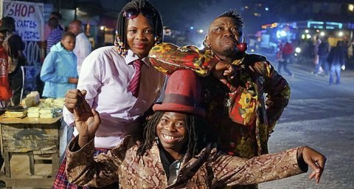


All these strategies to reduce the parasocial distance between a non-disabled viewer and a disabled screen character are complemented by the surprising combination of ‘wheelchair user’ and ‘travel presenter’.
For more information about shared identity configurations see Chapter 9.
The next section discusses extended intimacy.